Primary-source energy claim guide
Free Energy Research
A sober field guide for people searching free energy, over-unity devices, zero-point energy, water fuel, magnet motors, and the real renewable-energy research that does not require broken physics.
Citation-ready, not clickbait
Useful because it is strict
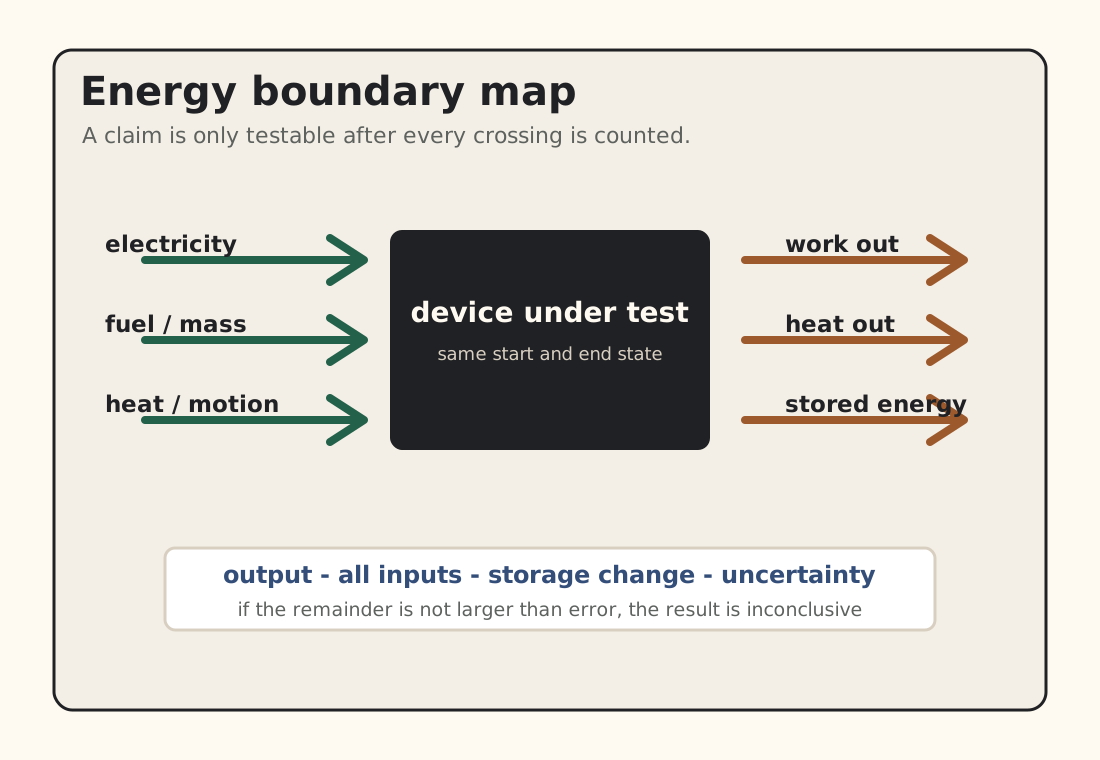
The site does not call every unusual idea fraud. It asks a narrower question: what exactly crosses the boundary, what does the measurement show, and is the evidence strong enough for the claim?
Core guide
Read by question
What "Free Energy" Means
Most confusion starts because the same phrase is used for legitimate thermodynamics, renewable energy, and extraordinary machine claims.
First principlesThe Physics Boundary: Conservation, Entropy, and Useful Work
Free-energy evaluation is mostly disciplined accounting: define the system boundary, count every input and output, and separate moved energy from created energy.
MeasurementHow to Test an Over-Unity Energy Claim
The fastest way to improve a free-energy conversation is to replace demonstrations with a written input-output protocol.
Evidence literacyPatents Are Not Proof of Net Energy
A patent can show that an inventor claimed and disclosed something. It does not, by itself, validate net energy performance.
What worksLegitimate Free-Energy Research: Renewable Flows and Efficiency
The best "free energy" research does not promise physics violations. It harvests real flows, reduces losses, stores energy better, and uses better systems engineering.
ReferenceClaim Index: Free-Energy Topics and Evidence Standards
Different free-energy topics fail or succeed for different reasons. This index maps each claim type to the evidence that matters.
Failure modesWhy Free-Energy Claims Fail
Most failed free-energy claims do not require exotic explanations. They fail because the boundary, meters, storage state, or replication standard was not strong enough.
Free tools
Use the standard, not the slogan
Over-Unity Claim Analyzer
Score a free-energy claim against the evidence standards that matter: measured energy, hidden inputs, storage, uncertainty, and replication.
Measurement calculatorEnergy Measurement Calculator
Compute a basic energy balance for electrical demonstrations and see when meter choice, power factor, storage, or uncertainty can erase a claimed surplus.
Claims databaseFree-Energy Claims Database
Explore recurring claim types from Keely through Rossi and compare each claim with the investigation or evidence gap that matters.
Primary sources
Built to be checked
Thermodynamics comes from NASA Glenn. Units and uncertainty come from NIST. Patent interpretation comes from USPTO materials. Renewable and hydrogen claims are grounded in EIA, DOE, and NREL references.
Open the source library